
Festivals & Celebrations in Ethiopia
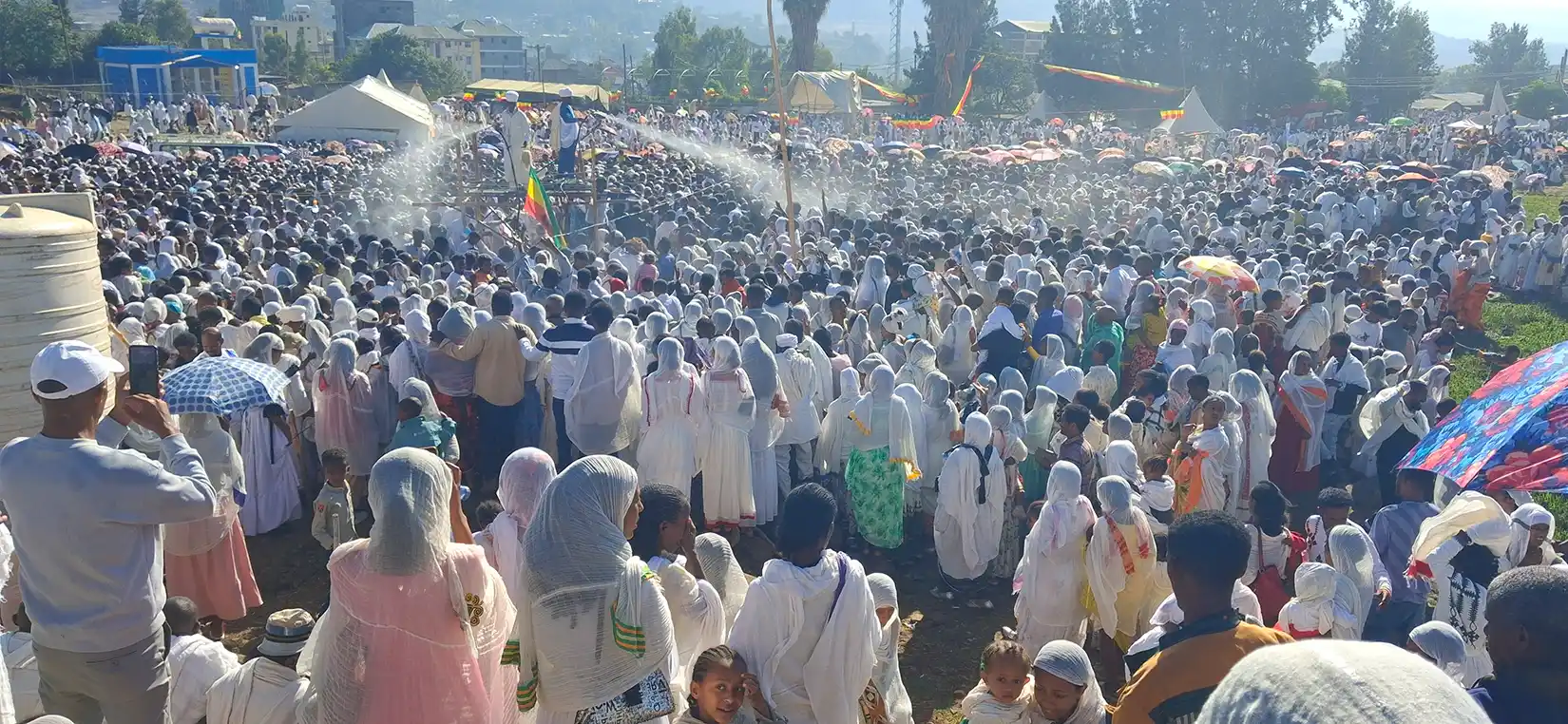
Timkat
Timkat, celebrated every January, is Ethiopia’s most famous religious festival. The celebration commemorates the baptism of Jesus Christ and features colorful processions, priests carrying sacred replicas of the Ark of the Covenant, traditional music, and public ceremonies. Cities such as Gondar, Lalibela, and Addis Ababa offer particularly spectacular Timkat celebrations.
Meskel
Meskel is one of Ethiopia’s largest annual festivals, celebrated in September to commemorate the discovery of the True Cross. The highlight of the festival is the lighting of enormous bonfires known as “Demera.” Thousands gather in public squares, churches, and communities throughout the country to participate in this colorful and deeply significant celebration.
Ethiopian New Year (Enkutatash)
Ethiopian new year falls on 11th September of Gregorian calendar, marks the perfect season, when yellow daisies (adey abeba) start to blossom in the midst of the green countryside, after the long rains end. The day is also linked to the Queen of Sheba, her famous travel to Jerusalem, and what happened afterward. It is the principal calendar used in the Ethiopian orthodox church as the liturgical year. A 7-8-year gap between the Ethiopian and Gregorian Calendars results from an alternate calculation in determining the date of the Annunciation.
The Ethiopian calendar has twelve months of 30 days plus five or six epagomenal days, which comprise a thirteenth month. The sixth epagomenal day is added every four years. Thus the first day of the Ethiopian year, is usually September 11 (Gregorian). It, however, falls on September 12 in years before the Gregorian leap year.
Gena (Ethiopian Christmas)
The Ethiopian Christmas falls on January 07 (or 08 during leap year) ever year and celebrates the birth of Jesus Christ. Christmas is warmly celebrated in Ethiopia after 45 days of Advent fasting before Christmas. It starts on 25th November and is known as the ‘Fast of the Prophets’ (Tsome Neviyat). This festival has a special place in the hearts of many Ethiopians—according to Ethiopian tradition, one of the Wise Men(Baltazar) who visited the baby (Jesus) at Bethlehem, was from Ethiopia. During this festival, night mass is conducted in all churches, people who go to churches to attend the night mass lit candles, most people, particularly, women wear white traditional clothes, priests and young boys and girls chant and dance, people play thousands of years old game, Gena, (one of Ethiopia’s traditional games which is much similar to that of the “hockey” game in Europe and America), choirs sing spiritual songs at churches and more.
Fasika (Ethiopian Easter)
Ethiopian Easter, or Fasika, takes place in Orthodox Churches throughout the country, and follows the eastern method of calculating Easter. Fasika is a much more important festival than Christmas, since the Death and Resurrection of Jesus is more significant in Orthodox theology than his birth. Jesus’ crucifixion which led to his death on a Friday, according to Orthodox thought was for the purpose of fulfilling the word of God, and led to the conquest of death and Jesus’ resurrection from the tomb after three days, the third day being the Sunday when Ethiopian Easter is celebrated.
Fasika is a climactic celebration. Fasting becomes more intense over the 55-day period of Lent, when no meat or animal products of any kind, including milk and butter, are eaten. Good Friday starts off by church going, and is a day of preparation for the breaking of this long fasting period.
The faithful prostrate themselves in church, bowing down and rising up until they get tired. The main religious service takes place with the Paschal Vigil on Saturday night. It is a somber, sacred occasion with music and dancing until the early hours of the morning. At 3:00 a.m. everyone returns home to break their fast, and a chicken is slaughtered at midnight for the symbolic occasion. In the morning, after a rest, a sheep is slaughtered to start the feasting on Easter Sunday.